Floats Don't Agree With Themselves
I was debugging a polygon-overlap test that worked locally and failed on the server. Same code. Same input. Different answer.
The function deciding the answer was small. Three points A, B, C; return the sign of (B - A) cross (C - A). That sign tells you whether a vertex is convex or reflex, whether a diagonal stays inside the polygon, whether a point is above a line or below. On x86, LLVM had folded the multiply and the subtract into a single fma — one rounding step instead of two. On WASM there is no FMA, so two roundings. A vertex sitting in the epsilon neighborhood of zero fell on opposite sides. From one bit of disagreement, the whole decomposition forked.
This wasn't a bug in my code. It was IEEE 754 working as advertised. The standard pins down the storage format. It does not pin down behavior. Reassociation, FMA contraction, x87 registers at 80 bits, denormal flush flags — four separate ways to get a different answer from the same inputs. Tightening tolerances doesn't help: convex decomposition is discrete. A vertex is reflex or it isn't. An epsilon at the input is a binary difference at the output.
So I wrote exact-poly, a 2D geometry library that uses no floats at all.
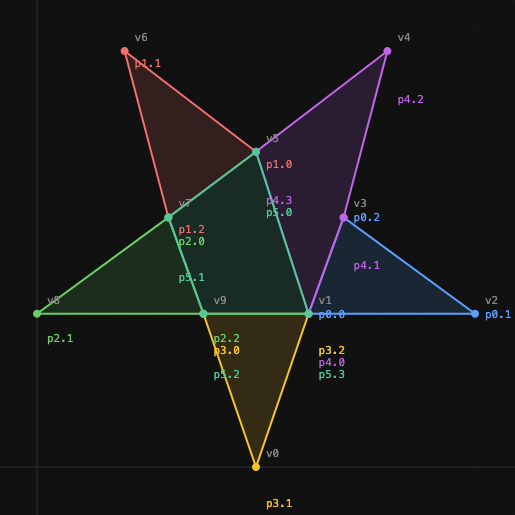
A 10-vertex star decomposed into 5 convex parts. Vertex labels (v0–v9) match input order; part labels (p0.0–p5.3) are emitted by the cascade. Sum of part areas equals the ring area, exactly.
- GitHub — mercaearth/exact-poly
- Live demo (7 tabs) — exact-poly.merca.earth
- In production — merca.earth runs
exact-polyin WASM client-side and at validation; pick a spot, draw a polygon, watch the samei64math accept or reject the claim on both sides